BewegungsLernen · Roland Pausch
Warum dein Problem in den Lendenwirbeln selten in den Lendenwirbeln liegt
Viele Menschen kennen es: Der untere Rücken meldet sich, die Lendenwirbel machen Probleme, vielleicht gab es sogar schon einen Bandscheibenvorfall. Und meistens wird dann genau dort behandelt, wo es wehtut.
Das klingt logisch. Aber oft greift es zu kurz.
Eine Verletzung trennt einen Teil vom Ganzen
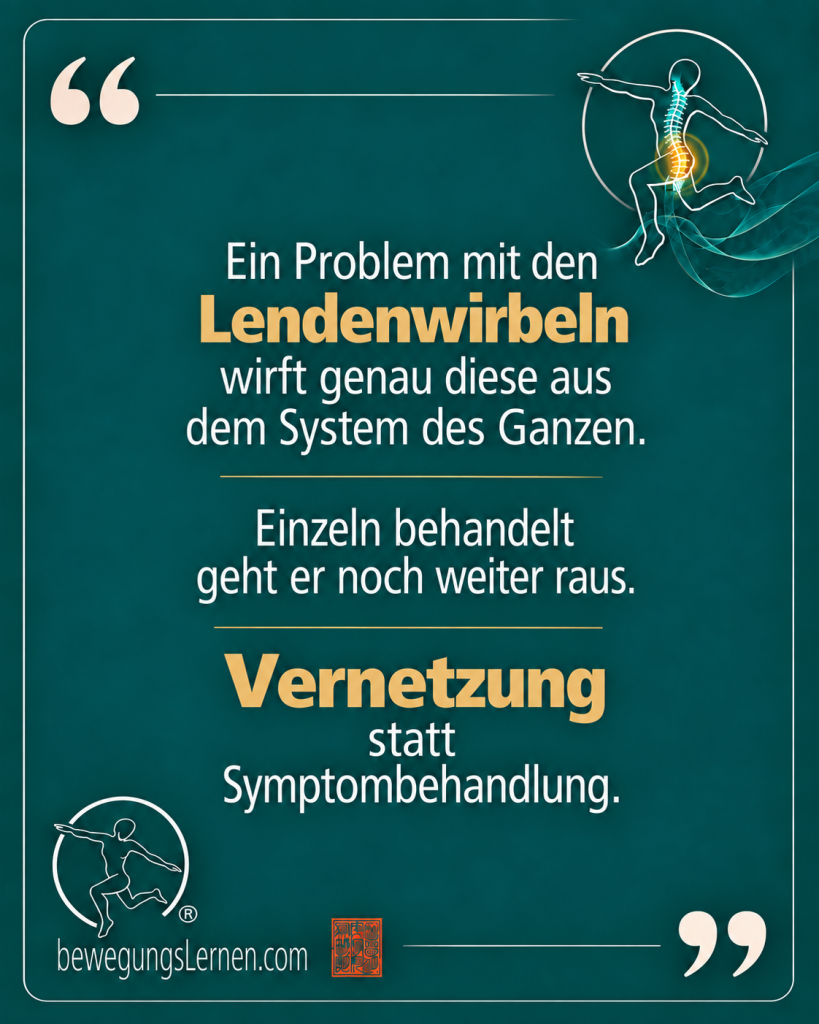
Eine Verletzung wirft den verletzten Bereich aus dem Körpersystem heraus. Und dann ist nicht nur dieser Teil betroffen, sondern der ganze Körper, weil er kein Ganzes mehr ist.
Wenn wir jetzt nur die Lendenwirbel behandeln, bringen wir sie oft noch weiter aus dem System heraus. Deshalb gehen wir einen anderen Weg: Wir arbeiten mit dem betroffenen Bereich und integrieren ihn anschließend wieder in den Rest des Körpers. Denn es ist der Rest des Körpers, der heilt und wieder einbindet.
Der Ursprung liegt selten dort, wo das Symptom auftaucht
Die Lendenwirbel haben das Problem kaum in sich selbst. Es entsteht, wenn ihre Bewegung von der Wirbelkette getrennt wurde. Wenn sie also nicht mehr mit den Brustwirbeln zusammenarbeiten, nicht mit den Halswirbeln, den Rippen, dem Brustbein, dem Becken, dem Beckenboden und dem ISG.
Sogar die Schultern spielen mit:
Was du mit deinen Schultern machst, wirkt also bis hinunter in deinen unteren Rücken.
Sechs Muskelschichten an den Brustwirbeln
Und hier wird es spannend. Selbst wenn die Brustwirbel in eine Behandlung einbezogen werden, wird meistens nur eine Muskelschicht bearbeitet, und zwar die ganz außen liegende.
Direkt an den Brustwirbeln liegen aber sechs Hauptschichten übereinander. Jede davon bewegt sich auf ihre eigene Art. Wenn ich zum Beispiel in die vierte Schicht hineingehe, schaue ich nicht nur, wie sie sich bewegt. Ich schaue auch, wie sie mit den Muskelschichten der Lendenwirbel verbunden ist. Arbeiten sie zusammen? Sind sie koordiniert, sind sie integriert?
Und das mache ich mit allen Schichten. Denn jede einzelne ist auch mit den Schultern, den Schlüsselbeinen und sogar den Ellenbogen verbunden.
Was hat dein Ellenbogen mit deiner Atmung zu tun?
Mehr, als du denkst. In den Kursen spürst du ganz direkt, wie dein Ellenbogen mit deiner Atmung zusammenhängt und mit der Bewegung von Brustbein und Brustwirbeln. Viele sind überrascht, wie deutlich dieser Unterschied ist.
Komplex im Hintergrund, leicht in der Umsetzung
Das alles klingt vielleicht kompliziert. In der Praxis ist es aber erstaunlich einfach. Wenn wir die Schichten und Verbindungen nach und nach wieder ins Zusammenspiel bringen, kommt Bewegung in deinen Problembereich, ob das nun die Lendenwirbel sind oder ein Bandscheibenvorfall. Und genau so entsteht Veränderung.
Erleben kannst du das in unseren Zweitageskursen.
Alle Termine ansehenBewegungsLernen · Roland Pausch
Why your lower back problem rarely sits in your lower back
Many people know the feeling: the lower back starts acting up, the lumbar spine is causing trouble, maybe there has even been a herniated disc. And usually the treatment goes exactly where it hurts.
That sounds logical. But often it falls short.
An injury separates a part from the whole
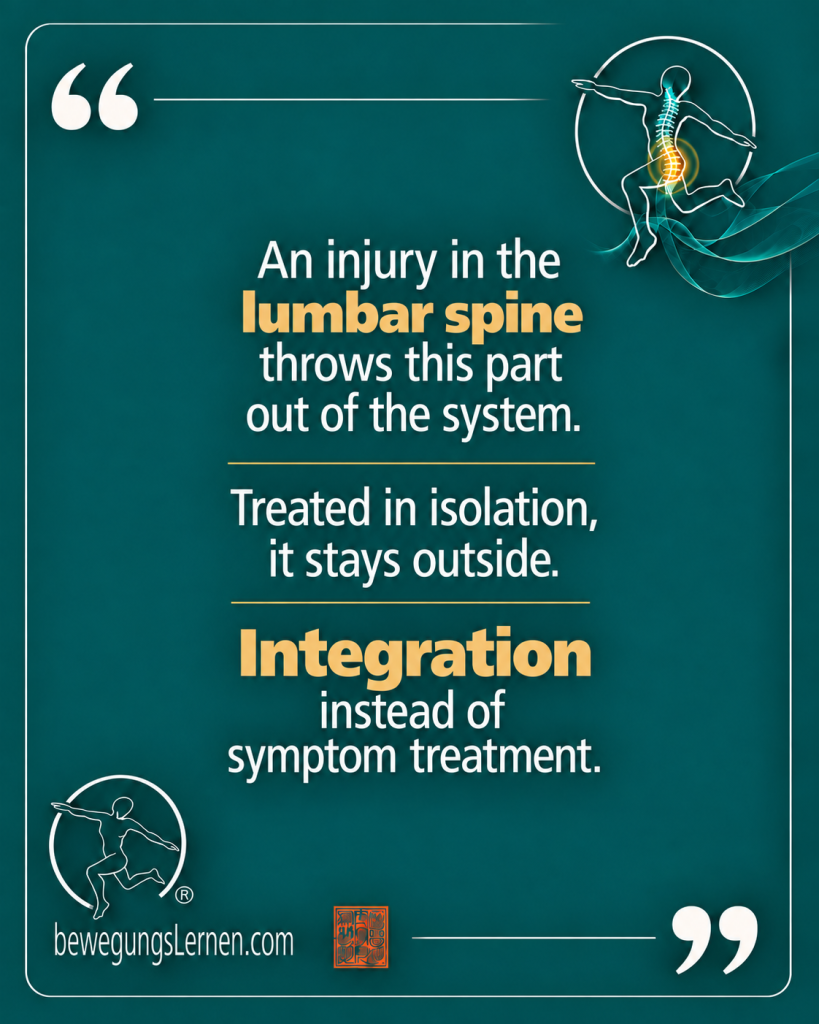
An injury throws the injured area out of the body’s system. And then it’s not just that one part that is affected, but the whole body, because it is no longer a whole.
If we only treat the lumbar spine, we often push it even further out of the system. That’s why we take a different path: we work with the affected area and then integrate it back into the rest of the body. Because it is the rest of the body that heals and brings it back in.
The origin is rarely where the symptom shows up
The lumbar vertebrae hardly ever have the problem in themselves. It develops when their movement has been separated from the spinal chain. When they no longer work together with the thoracic vertebrae, the cervical vertebrae, the ribs, the sternum, the pelvis, the pelvic floor and the SI joint.
Even the shoulders play a part:
So what you do with your shoulders reaches all the way down into your lower back.
Six layers of muscle at the thoracic spine
This is where it gets interesting. Even when the thoracic spine is included in a treatment, usually only one layer of muscle is worked on, and that is the outermost one.
But right at the thoracic vertebrae there are six main layers lying on top of each other. Each one moves in its own way. When I go into the fourth layer, for example, I don’t just look at how it moves. I also look at how it is connected to the muscle layers of the lumbar spine. Do they work together? Are they coordinated, are they integrated?
And I do this with every layer. Because each one is also connected to the shoulders, the collarbones and even the elbows.
What does your elbow have to do with your breathing?
More than you think. In the courses you feel directly how your elbow is linked to your breathing and to the movement of your sternum and thoracic spine. Many people are surprised by how clear this difference is.
Complex in the background, simple in practice
All of this may sound complicated. In practice, though, it is surprisingly simple. When we bring the layers and connections back into working together step by step, movement returns to your problem area, whether that’s the lumbar spine or a herniated disc. And that is exactly how change happens.
You can experience this in our two-day courses.
See all dates